Sunday, 26 June 2011

an excellent adventure

 
Aimag- a Mongolian province
Hovsgol- an aimag bordering Siberia
Moron- Hovsgol’s capital
Tsagaan Nuur- the northernmost town of Mongolia’s northernmost aimag
Taiga- the geographical region where the Tsaatan live
Tsaatan- Mongolia’s smallest ethnic minority, also known as the Dakha.  The Tsaatan herd their reindeer in the Eastern Saya Mountains spanning the Siberian and Mongolian border.

I should provide some context. 

The original plan was to spend our first six weeks in Mongolia working with the Itgel Foundation, an NGO focused on Tsaatan community and reindeer health.  Itgel indicated that they could make use of us in some of their education and surveillance work.  But there is no Internet in the area that the Itgel Foundation serves, and our contact with them was inconstant.  Upon our arrival in Mongolia, we asked around and determined that our contact and Itgel’s founder, Morgan Keay, had returned to the United States, and that Itgel’s activities were effectively suspended until further notice.  The details surrounding this conclusion were hazy, but at any rate Morgan was no longer responding to our emails, and it looked like we were SOL.  We continued to ask around and soon a friend introduced us to a friend who put us into contact with a friend.  This friend was the founder of the grassroots NGO The Reindeer Fund, which works to improve socioeconomic opportunities and promote education in the Tsaatan community.  His name was Sukhbaatar, a bewhiskered old gentleman with a deliberate, patient way of speaking and beautiful penmanship.

With the help of a long-suffering translator, we interviewed Dr. Sukhbaatar about his work, and he encouraged us to travel to the taiga region.  Dr. Sukhbaatar, being familiar with veterinarians and students, knew that we would find it interesting.  In fact, he turned us on to a veterinary friend of his who had plans to travel to Tsagaan Nuur and the taiga the following week. 

Dr. Namsalmaa was busy with her own research, as well as an American veterinary student from Cornell, and a conference being held in Tsagaan Nuur.  Nevertheless she was perfectly friendly and gave us tentative dates for when she would be in the region.  

Dr. Nansalmaa and Jocelyn from Cornell
So we began planning our trip.  For three days we ran around like startled goats, procuring boarder permits, letters of endorsement, residency cards, supplies, and advice.  The population density of Hovsgol is 1.34 people/km2, so we did our best to organize logistics ahead of time, our Mongolian friends acting as translators through distant cell phone connections. 

We received dire warnings and cautionary tales.  We were advised it would rain the whole time and freeze overnight.  

“You have a good tent right???” Sukhbaatar’s daughter asked, and I tried to nod confidently, thinking secretly of the moldy old thing I’d unearthed from its thirty-year hiatus in my parents' garage.  

We were warned of the gold miners, and advised to avoid looking conspicuous (ha).  We were warned of the military, and told to avoid looking Russian.  We were warned of the spirited taiga ponies, and were begged to avoid well-aimed and sharp little hooves.

pretty boy
 
A long-time American fishing guide we met in the airport raised one eyebrow at us:
“You’re going to West Taiga?  Please, when your horse falls belly-deep into a bog, take your feet out of the stirrups,” he drily said.
“Duly noted,” I replied.  I would have raised an eyebrow myself but alas I don’t possess that particular talent.   

I wondered for just a second if we weren’t jumping in over our heads.  At any rate, by the end of three days we were as prepared as we’d ever be, with camping equipment, riding boots, rain gear, gifts, and nine day’s worth of food packed into two backpacks.  This might have conjured a moments pride if we weren’t in a country where a man will travel several weeks with nothing but the del on his back and a lump of rock-like cheese curd in his pocket. 

So anyway, we flew to Moron.  Three hours at the military office, and then into a Soviet era minivan.  The roads are countless dirt tracks etched into the terrain, crossing, separating, and converging again like bundles of ribbons.  Shades of green and shadow impart an endless quality to the hilled landscape.  And from a minivan, that’s where the beauty ends.  Thirteen bone-crunching, joint powdering, stomach-churning hours later, we were in Hovsgol’s northernmost town.  

Nansalma had unexpectedly stopped to visit family on the way up, so for the time being she was MIA.  We camped in the back yard of a local friend, Bayarma.  Her young daughters brought us salty milk tea and sweet homemade blueberry juice.  The next day we were introduced to a local guide and his horses, and set off for the taiga.  

Bayarma's house in Tsagaan Nuur.  The younger sister is attempting to climb the ladder, while the older sister in the loft is trying to tip her over.
 
Tsagaan Nuur
in Tsagaan Nuur

rowing on the lake in Tsagaan Nuur


As is usually the case, nothing turned out to be as bad, or as difficult, or as dangerous as we were led to believe.  I can see what the American meant about the bogs, although happily none of our party succumbed to that fate.  And the miners left us alone, or should I say, the Ninjas. 


I spotted a Ninja

Micheal Kohn did a pretty great job of illuminating the Ninjas for Lonely Planet, so I’m stealing his blurb here. 

Nomads to Ninjas

Miners indulging in Mongolia’s great new gold rush are turning verdant plain and pure rivers inside out in search of buried fortunes.  But for once, its not just the megacorporations from Ulaanbaatar that are to blame, it’s the Ninjas. 
When severe winters in the beginning of the millennium wiped out entire herds and family fortunes, many impoverished nomads turned to illegal gold mining in Bulgan, Tov, and Selenge aimags.  The green, shell-like buckets strapped to their backs, coupled with their covert night-time operations, earned them the moniker ‘Teenage Mutant Ninja Turtles,’ or Ninjas for short. 
The Ninjas, who often pan what larger mining corporations dredge from the flooded plains, attracted interest from businesspeople who sold them food and supplies.   Soon ‘Ninja ger boomtowns’ developed, each with ger-butchers, ger-shops, ger-karaoke barrs, ger-sega parlours, and ger-goldsmiths.  Police have tried, often vainly, to break up the settlements, but the Ninjas return in larger numbers.
The Ninjas, who number more than 100 000, pose a serious threat to the environment and themselves.  Unlike the licensed mining companies, they don’t clean up after themselves; their work sites are often littered with discarded batteries and open pits.  Mercury and cyanide, used to separate gold from the rock, add more problems.  Health workers report that miners who use these methods have levels of mercury in their urine that are five to six times the safe limit.      
Ninjas account for an incredible US$140 million in gold exports (although official bank numbers say US$40 million).  They receive US$500 per troy ounce, completely illegal and untaxed.  Most Ninjas earn US$16 to US$24 per day.  This kind of money, ten times that of other rural salaries, has attracted more than out-of-work nomads.  They’ve been joined by pensioners, redundant farm workers and poorly paid civil servants.  Students who come in summer are able to finance their entire university education. 
But this is dangerous business— a couple dozen Ninjas are buried alive in mine shafts each year.  Recognising that the Ninjas won’t go away, the government has considered ways to legalise their activities, protect their health, and clean up their mess, if for no other reason than to tax their cache, which is mostly smuggled to China.


Two days of gorgeous mountain riding brought us to the Tsaatan summer camp, which was just getting underway.  


enjoying a tin of horse meat in the tent

wheee!


Itgel provides a summary of Tsaatan culture on their website, so for more context refer to that.


Saturday, 11 June 2011

calves are freakin' cute

one eye on the camera!


cow painting

 
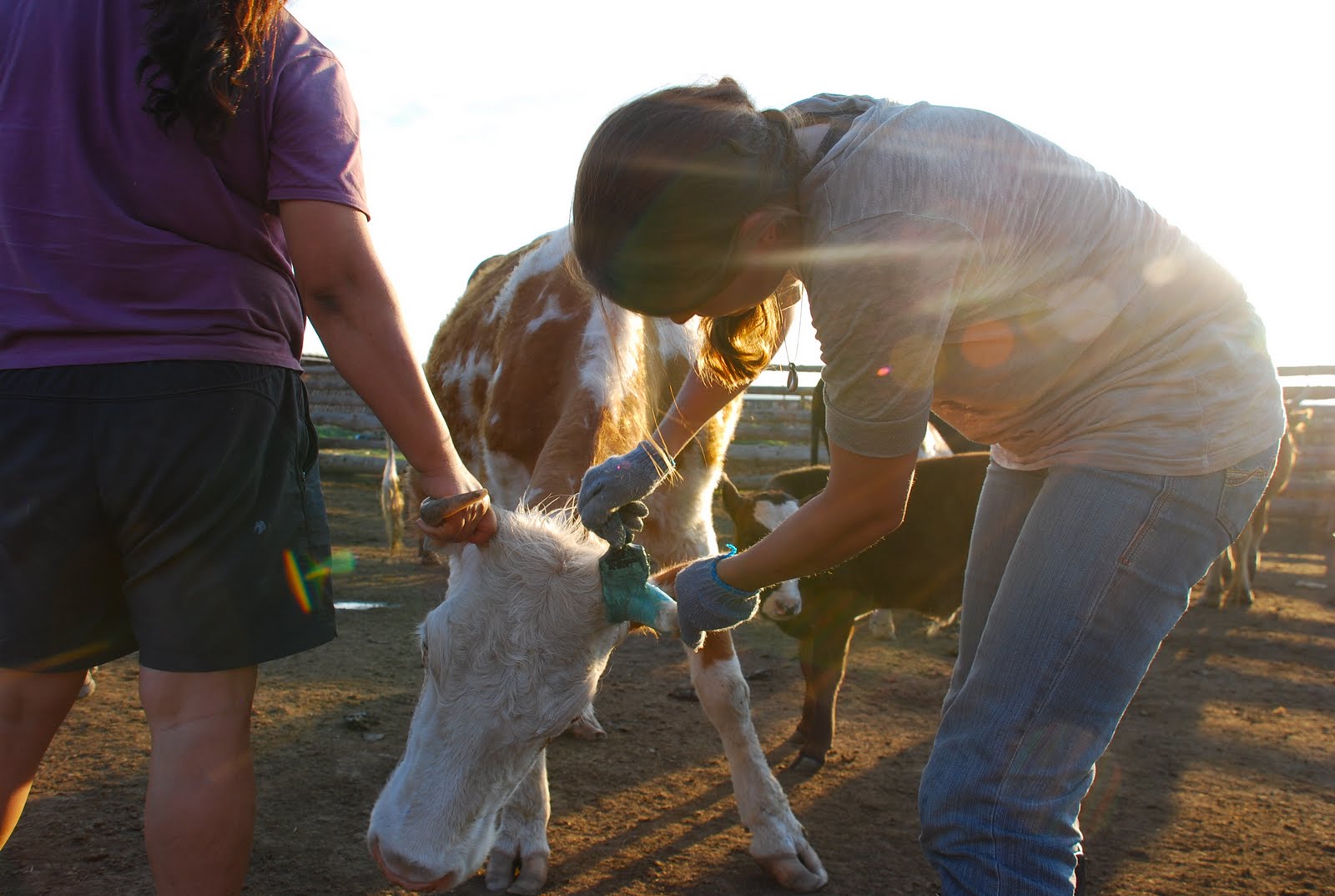
Cattle-rustling is a significant problem in Mongolia, and branding is ubiquitous but insufficient.  So Minja, Martin’s wife, paints her cattle green.  It’s chancy moving stolen cattle when they’re green. Anyone who sees you is going to remember.
She paints the left horn, and the right flank.  Cattle don’t really like being painted, and there’s no squeeze chute.  But one horn can be used as a convenient handle to keep the animal from running away on you while you're painting the other one.  The cattle were penned up in the courtyard, and they were pretty riled up by the time our job was half finished.  They’d sort of begun stampeding with nowhere to go when somebody let the horses out.  With the horses galloping around, the courtyard was a bit like a meat grinder.  Cattle were getting difficult to catch, and it was the rambunctious ones that were left over.  We needed help, so the nineteen-year-old boys were released from the wood-shop.   

Teenage farmhands do not approach cattle wrassling in a calm or controlled manner.  Imagine a courtyard full of stampeding horses and cattle, with nineteen-year old boys flying through the air and over water troughs, while others waterski from the ends of tails and Dayle and I frantically run around with green paint-brushes.
At any rate, the job got done.

      
A picture from before things got wild and the camera was put safely away.

Mongolia and the 21st century

 
There aren’t many nomadic cultures left in the world, and I guess that’s a major draw for Mongolia.  It was for me.  The minimalist lifestyle of an itinerant people is a romantic concept for kids like me, refugees of consumerism who think that going a couple weeks without running water will wash us clean of our capitalist disposition.  So I would be sad if nomadism was phased out in Mongolia, not because I have a clear understanding of what that change would mean for the country and its herders, but because I love the idea of it. 

There’s a lot of talk around here about where the nomadic lifestyle is headed, and opinions differ.  Some people say that the system is no longer sustainable.  They talk about a natural progression from pastoralism to agriculture.  Others point out that simply replacing one system with another seemingly more efficient one is unjustifiable because pastoralism already serves multiple purposes in its social and ecological contexts.  If one person says that herders, as low-intensity producers migrating from pasture to pasture, are protectors of the environment, then the next person will claim that herders, as a result of not being sedentary, have no respect for the land or their lasting effects on it.  There is lots of talk.  However, there are a few things that, as far as I can tell, are probably true.   

Nomadic society is not the unsophisticated predecessor to sedentary agriculture.  Historically, the economics and politics of mobile pastoral systems in Mongolia have been stratified and complex.  The constraints of mobile pastoralism do not limit political organization or social complexity.  

Herders do not wander in search of food and water.  They undergo defined periodic migrations to known pastures in the appropriate season.  Some only travel a couple of kilometers, for example, to benefit from a windy area during mosquito season or to be sheltered by a steep foothill in the winter.  Others cover much larger distances.

Nomadism is not a timeless traditional society just now beginning to feel the winds of change.  Neither was Soviet-influenced collectivization in 1929 its first transformation.  Migrations have been changing with politics, religion, and leadership in the region since pretty much forever.

With no clear ideas about where herding is headed in the 21st century, I like listening to people talk about it.  Livestock production interests me— go figure. 

We spent a few days a day's train ride North of UB on a ranch, participating in one case-in-point.  The place is run by a sixty-year-old German/ Russian-Kazakh man with an Australian accent.  His name is Martin.  He’s a mean old bastard, but the type that garners love and dependence from his family and employees.  He has an education on him: an ex-miner, carpenter, soldier for the German army and the French Foreign Legion, a lawyer, and now a rancher with a tough Mongolian wife thirty years his junior.  When he finds a viper in his garden, he throws it live into his neighbour’s yard. 
In six years he's transformed his land into an impressive and ongoing accomplishment.  They seeded pasture by hand, stampeding the animals up and down the acres to press the kernels deeper into the soil.  They built a silage pit, a dairy barn, a green house, and a pizza oven.  They cut hay with scythes.  They planted deciduous trees now shading the property.  There’s no farmhouse; the family and employees live in gers.  They turned one ger into a smoke house.  The only plumbing is used to water the garden and heat the dairy barn in winter.  

Martin talks a lot about overcoming Mongolian traditional approaches to food production.  At every turn, Martin boasts, the family told him that what he was doing would not work in Mongolia.  And when his methods succeeded, there was all the same a lingering reluctance to continue them.

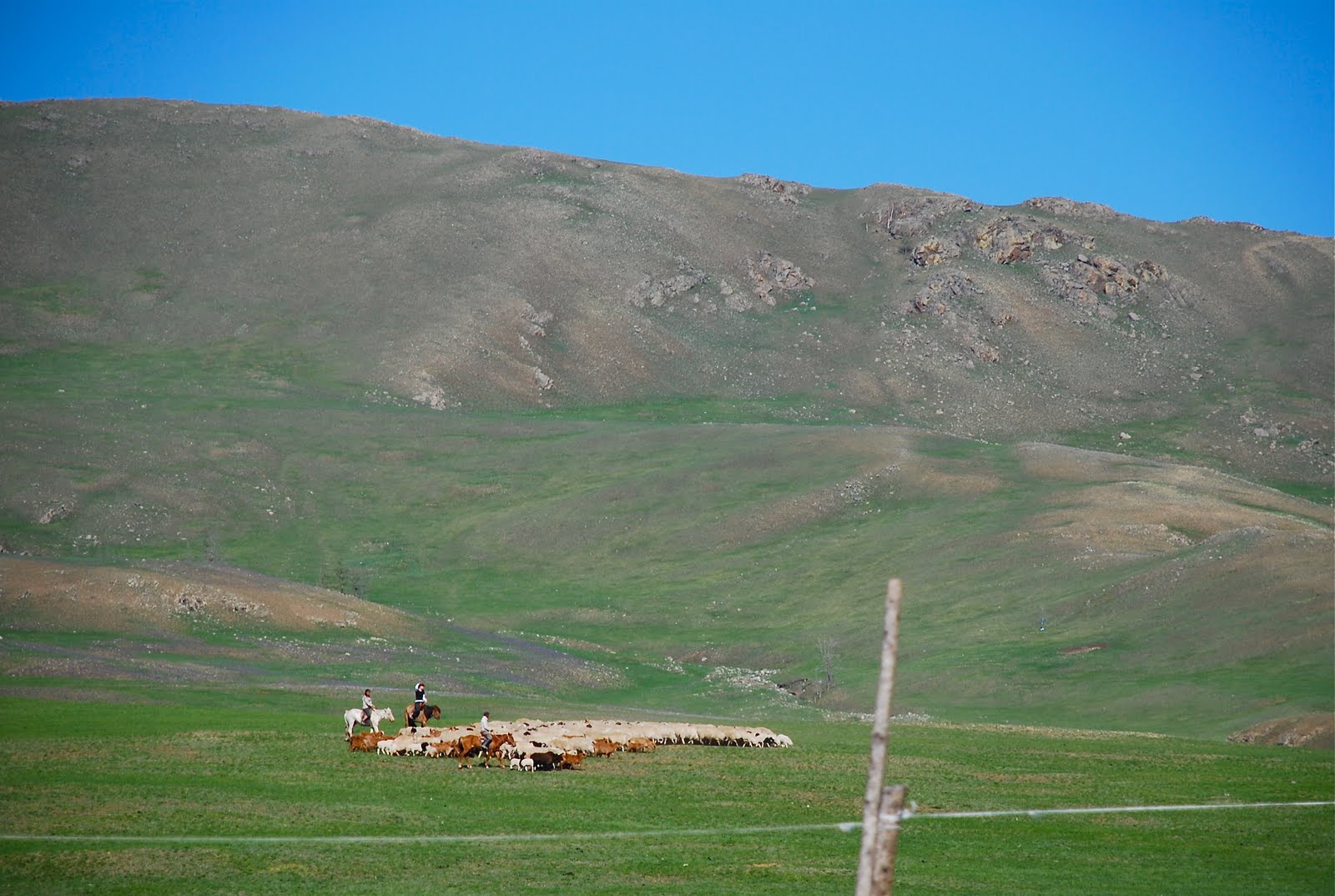
However, Martin and his family have not rejected the nomadic system out of hand.  While we were there, preparations were being made to move the animals to their cultivated summer pasture, three kilometers away.  A couple of gers, and three new employees would go with them.  I asked Martin if it wasn’t easier to have someone herd the cattle that distance for the milking in the evening/morning, rather than move the gers, fences and supplies.  But this way, the cattle are back out on pasture immediately after milking.  The saved time the animals spend grazing and not walking contributes noticeably to the weight they put on over the summer.  So even Mongolia’s model ranch still moves gers to summer pastures with the livestock.

In a country with the world’s second highest prevalence of brucellosis, Martin’s herd is brucellosis-free.  They test the herd every three months, and Martin explained how forcing the local veterinarian to use separate needles for each cow almost came to blows and a divorce.  He claims he is forced to throw the used needles in a pit and cover them with cement to prevent the family from rinsing and reselling them.  The government provides needles to veterinarians for brucellosis testing, and his vet sells these on the black market.

I thought that Martin’s frustrations were fairly typical of any aged, intelligent, and hardworking person, although Martin thinks differently. 

“Mongolian people are the stupidest you’ll ever meet,” he explained on several occasions.  “There’s just nothing up there.”

To me, this estimation typifies a familiar ex-pat tendency to characterize human behavior in their host country as something unique to that region, and to credit a particular history, culture, nationality, or “race”, with its inception. 

Speaking to one senior American diplomat at a party, I was informed that Mongolians don’t value their environment, leaving garbage and debris wherever they’ve been.  “This is the communist hangover,” said the old diplomat.  “If it’s not mine, its nobody’s.” 

I thought about that for a moment.  “Well I spent the last four summers living in bush-camps with Canadians,” I began, “and the only reason anything was ever picked up behind us was because the company forced it, and that was only to avoid government fines.  The camps became disorganized trash heaps in a matter of weeks.  We dug pit latrines, but planters preferred to defecate in the woods around their tents, even if their tents were close to the river from which we pumped our water.  And these were all university-educated young adults from a country that’s been capitalist and democratic since its confederation.  I don’t doubt you’re correct in saying that a communist history still influences the present, but it’s also true that people commonly behave this way elsewhere.”  The old diplomat gave me a strange look.  I think he was contemplating my impertinence, and not my opinion. 
I hold no convictions about the future of herding, the merits of pastoralism, or the efficiency of farming.  My opinion at this point is that people are sometimes too loose with their logic, when it comes to ideas about cause and effect.


Reining in a Mongolian pony for a picture.  Dayle doesn't enjoy the "out-of-control" feeling, so I am forced to behave myself.


upgrading the party bucket


Anak Ranch


Milking.  The ranch has a milking machine, but the employees don't like to use it.


Making better yogurt than you can imagine


Making fermented cow's milk (Tairag).  They then distil the alcohol from the Tairag and make moonshine.


Dried manure stored for winter burning in the gers.  The other side of the barn is packed with coal.

The wood shop where they make pine boxes to sell to the mining company.  The boxes are used  for shipping mineral samples back to Canada.


Climbing hills again


Slicing cheese curd for drying on the roof


delicious fresh milk


watching TV in the ger


cheese curd drying in the Sun

soft tendons


banding calves

Friday, 10 June 2011

leaving Ulaanbaatar

 
       Two weeks and three traffic accidents later and we are finally leaving the capital.  Scenes from rural Mongolia are vastly different from Ulaanbaatar, where women dressed like Russian pop-stars deftly navigate their four-inch stilettos through noisy construction sites, around the hummers vying for space on potholed roads, over the unconscious drunks who decorate the city’s sidewalks and staircases.

       I like this place. 

       There’s a diverse collection of musicians, a theater, a ballet, an opera, a circus, and drinking buddies to be found on any night of the week.  But the relentless thrill of jackhammers and swinging cranes is beginning to affect my nerves.  Deafening traffic chokes every street, and everything smells like mutton, even the bank notes.  Especially the bank notes.

       I’m going to risk inevitable cliché here, and comment on the traffic.  I’ve found this same paradox in many countries; there’s no hurry to go anywhere until you’re behind the wheel of a car, and then suddenly it’s a careening race of death.  Maybe this is the common cultural thread that sedentary Ulaanbaatar shares with the rest of her country.  Everyone is perfectly content to spend an afternoon in the ger, sharing family news, eating deep fried snacks, and drinking vodka.  We get fuller, and drunker, and warmer, and lazier as the day wears on, the stove continues to burn, and the salty milk tea flows.  Then at some point there is occasion to remove ourselves from our inebriated languor and mount a horse, and I am suddenly tearing after my companions like the wind on crack. 

       Given the choice between death by hummer or horse, I pick horse, hands down.  So it’s off to the countryside I go. 

Yeehaw.  


Spongebob and the Russian tank


herding sheep and goats


a young girl by the river and a young horse feeling the effects of a recent castration (sans anesthetic)


The view from our dorm.  Every once in a while a truck startles a herd of horses into running back and forth through the neighborhood.


Successful exchange of knowledge is a gratifying thing.  It feels like a small triumph of humanity.  While visiting a family of herders, the father told us his greatest losses in sheep were due to uterine prolapses at lambing.  Here’s a picture of Dayle with a scrap of fabric, cotton string, and a large curved needle from the ger sewing kit, demonstrating ways to sew up a prolapse.  The father seemed pleased with the technique.  Then we all moved on to enthusiastically discussing the merits of different breeds of cattle.  So that was nice.    


The daughter of veterinarians we know with a family friend in the country


Making mutton pancakes.


A Kasakh man with his golden eagle.  The Kasakh are a Mongolian Muslim nation, and use their eagles to hunt fox and wolves.  This man brought his bird near Ulaanbaatar for the summer to make money off the tourists.

gers and pubs

 
The Mongolian ger is a one-room felt and canvas-wrapped home built from a wooden lattice, two support columns, and orange roof poles fanning out like the spokes of a wheel.  Well over half of modern Mongolians have grown up in this setting, which negates notions of privacy, inhibition, possession, and personal space.  I can’t help but presume a causative link between Mongolian culture and this home environment.  Mongolians are friendly, pointed, and honest in conversation, patient with inconvenience, and accommodating to foreigners.  They have almost no sense of personal space, and they don’t knock.  They tell you what they are really thinking, and usually these are nice things.

Where this candid tendency can become especially amusing is at the pub, where middle-aged men aren’t always thinking nice things.  For those of you who don’t know, Mongolia fosters a relationship with vodka much in the same way that Russia does.

One particular evening comes to mind.  Dayle and I were at Ikh Mongol with an Australian/Fijian backpacker we met at the museum.  We were all having a lovely time, and so were the three Mongolian lawyers at the table adjacent.  In a Mongolian pub, the table adjacent almost always ends up joining your table, and after becoming extremely drunk the lawyers scooted over to share some very important advice with Dayle and I. 

Our friend Paul, you see, was simply not up to snuff.  They could see what was going on, and they were determined to dissuade us from our chosen course.  I guess I can see where they got the idea.  Paul, having just come from climbing mountains in Tibet, bore a certain resemblance to a young Brad Pitt, and that can put a woman in a vulnerable position.  The drunk men stood unsteadily and gesticulated when speaking, giving the impression of court proceedings. 

His clothes were of poor quality, they said.  He was clearly impoverished.  He had no life experience.  His penis was small!  Paul endured the prosecution with remarkable grace, while Dayle and I howled with laughter.